What Age Is Good for an RC Car?
Quick Answer
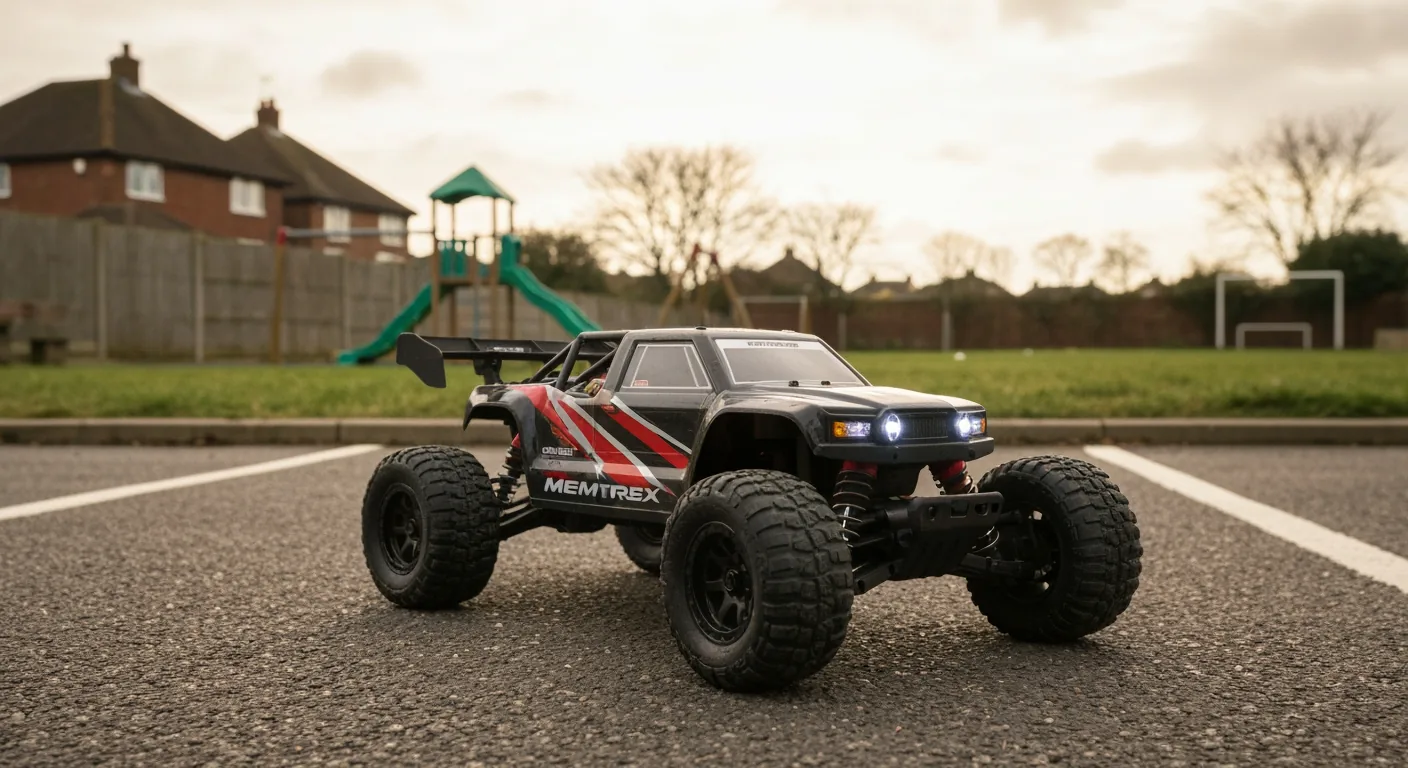
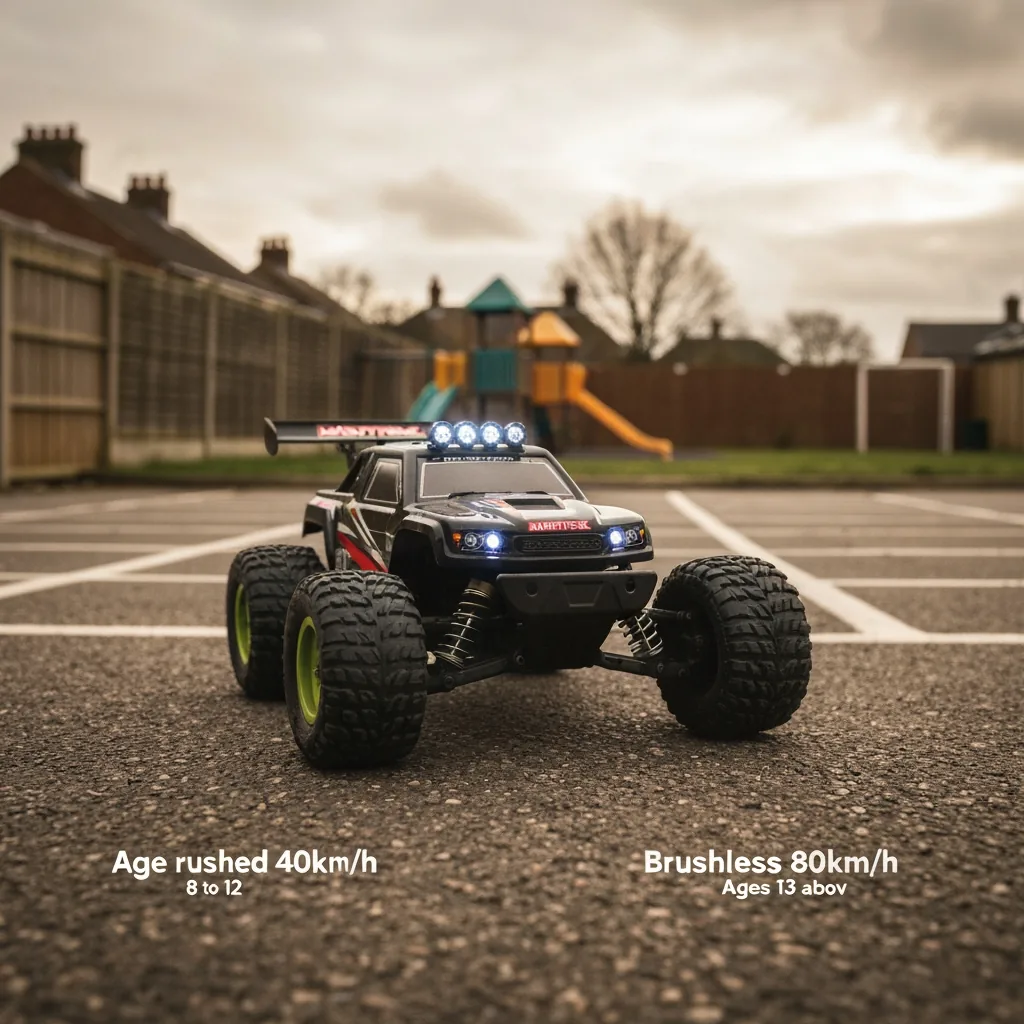
RC cars are suitable from age 6 onwards, with the right car matched to the right age bracket. A 6-year-old needs a simple, slow, robust toy-grade car with minimal controls. An 8-year-old can handle a hobby-grade brushed car at 40km/h with parental supervision on first use. A 12-year-old can drive a brushed car independently and is ready for supervised brushless. A 14-year-old can drive brushless unsupervised in most environments. Adults can drive anything — and usually should start with brushless if they intend the hobby to stick. The MemTrex Standard at £69 is the right answer for ages 7–13: brushed motor, 40km/h, genuinely hobby-grade repairability, appropriate speed for garden and park use without supervision beyond the first session or two. The MemTrex Pro at £149 is the right answer for ages 14 and above: brushless 80km/h performance, adult-level speed and responsiveness, the quality that keeps the hobby interesting. Both are RTR — battery and charger included, open and drive in 30 minutes. The single most common mistake UK parents make when buying an RC car is selecting by age range on the box rather than by speed and motor type. A box labelled 8+ can contain a toy-grade sealed car that will break in six weeks, or a hobby-grade brushed car that will last years. The label is not the criterion; the motor type and spares availability are.
RC cars are suitable from age 6 onwards, with the right car matched to the right age bracket. A 6-year-old needs a simple, slow, robust toy-grade car with minimal controls. An 8-year-old can handle a hobby-grade brushed car at 40km/h with parental supervision on first use. A 12-year-old can drive a brushed car independently and is ready for supervised brushless. A 14-year-old can drive brushless unsupervised in most environments. Adults can drive anything — and usually should start with brushless if they intend the hobby to stick. The MemTrex Standard at £69 is the right answer for ages 7–13: brushed motor, 40km/h, genuinely hobby-grade repairability, appropriate speed for garden and park use without supervision beyond the first session or two. The MemTrex Pro at £149 is the right answer for ages 14 and above: brushless 80km/h performance, adult-level speed and responsiveness, the quality that keeps the hobby interesting. Both are RTR — battery and charger included, open and drive in 30 minutes. The single most common mistake UK parents make when buying an RC car is selecting by age range on the box rather than by speed and motor type. A box labelled 8+ can contain a toy-grade sealed car that will break in six weeks, or a hobby-grade brushed car that will last years. The label is not the criterion; the motor type and spares availability are.
The Short Answer — Every Age Bracket Has a Hobby-Grade Option
There is no age too young for an appropriate hobby-grade RC car, if appropriate is correctly understood. The RC community's editorial consensus — reflected across rcgeeks.co.uk, and the r/rccars community — is broadly: brushed for under-13, supervised brushless from 12–13, unsupervised brushless from 14.
Hobby-grade RC cars — meaning cars with replaceable parts, real motors, and genuine durability — start to make sense from age 7 onwards. Below 7, the hand-eye coordination and sustained attention required to control a hobby-grade car safely is not yet reliably developed, and a toy-grade car is the correct choice. From age 7 upward, a hobby-grade brushed car at 40km/h provides a genuine and sustainable experience: fast enough to be thrilling, controllable enough to be learnable, durable enough to survive the inevitable crashes. From age 14 onwards, brushless performance becomes appropriate — the reflexes, spatial awareness, and risk judgement required to manage 80km/h in a park or open space are typically present by mid-teens, and the experience of brushless speed is qualitatively more rewarding for older drivers than brushed. Adults can drive any tier but should choose brushless if they intend to sustain the hobby beyond the first six months. The RC community's editorial consensus — reflected across RCGeeks, Radio Controlled UK, and the r/rccars community — is broadly: brushed for under-13, supervised brushless from 12–13, unsupervised brushless from 14. These are not rigid rules but practical guidance based on extensive community experience.
The supervision question is often more relevant than the age question. A mature, cautious 11-year-old in a large open park can drive a brushed 40km/h car entirely independently with no safety concerns. An impulsive 13-year-old in a small terraced garden probably should not be given unsupervised access to 80km/h. Know your child, not just the number on the birthday cake.
Age 4–6: Supervised Toy-Grade Only, No Hobby-Grade Yet
The first RC cars — what they need and why hobby-grade is premature.
Children aged 4–6 typically have the hand-eye coordination for very simple two-stick RC controls but lack the spatial awareness and predictive steering to manage a car at hobby-grade speeds on outdoor terrain. Under the UK Toy Safety Regulations 1995, hobby-grade RC cars are classified separately from toy-grade products — a distinction that matters when matching the right product to the right age. For this age group, toy-grade RC cars at 10–15km/h on smooth indoor floors or driveways are entirely appropriate. The cars should be simple to control — ideally with only forward-reverse-left-right functions and no variable throttle modulation — and robust enough to survive being dropped from table height, driven into walls repeatedly, and occasionally sat on. Toy-grade cars in the £15–35 range from supermarkets and toy shops are the correct product for this age group. Hobby-grade cars — including both MemTrex models — are not recommended for under-7 children, not because they are unsafe in an absolute sense but because the experience will be frustrating: a child who cannot yet predictively steer will crash repeatedly, which at hobby-grade speeds causes more frequent breakages and requires adult assistance to repair. The experience at toy-grade speeds on a simple car is more enjoyable and developmentally appropriate for under-6 children.
This is not a patronising restriction — it is an acknowledgement that matching the product to the developmental stage produces a better experience for the child. A 5-year-old given a 40km/h hobby-grade car will be excited for 10 minutes and then frustrated; the same child given a 12km/h toy-grade car at an appropriate skill level will have a genuinely enjoyable 20 minutes. The right car is the one that matches the driver, not the one that looks most impressive in the box.
Age 7–9: Entry Hobby-Grade Brushed — The MemTrex Standard Range
Where the real RC hobby begins. For age-specific guidance, see our RC car for 8 year old guide.
Children aged 7–9 can handle a hobby-grade brushed 1/16 RC car with appropriate supervision on first sessions. The key developmental threshold crossed between age 6 and 7 is predictive steering: the ability to anticipate where the car is going and steer to correct before the problem is visible, rather than steering reactively after it. At 40km/h, a 1/16 hobby-grade car requires this predictive ability — and most 7-year-olds have enough of it to begin developing the skill, which itself is part of the appeal. The MemTrex Standard at £69 is the textbook recommendation for this age group: 40km/h brushed, 4WD for easier control on grass and rough terrain, hobby-grade durability with UK spares, and a 2-year chassis warranty. An 8-year-old will drive this car well enough to enjoy it independently within 2–3 sessions. By 10, the same child will be driving confidently and exploring jumps and terrain with genuine skill. The car provides multi-year value because hobby-grade build quality means it does not break down as the driving improves — it grows with the driver.
Parents buying for a 7 or 8-year-old should plan for 2–3 supervised sessions at the start. The first session in particular benefits from the adult explaining steering anticipation and throttle control before the child drives freely. This is not overparenting — it is the difference between a child who crashes 30 times and gives up and a child who learns the fundamentals and is still using the car two years later.
Age 10–13: Brushed or Low-End Brushless, Supervised Brushless from 12
The competence window that spans the widest range of RC car options. See also our RC car for 10 year old guide for this bracket.
Children aged 10–13 are the most variable group in RC terms, because individual competence varies significantly. A confident, spatially-aware 10-year-old who has been driving brushed RC cars for two years may handle a supervised brushless session well. A 13-year-old who is impulsive and drives at full throttle in confined spaces is not ready for 80km/h unsupervised. The general guidance for this age group: 10–11 years, remain with brushed. The MemTrex Standard at 40km/h has plenty of room to grow — the driver becomes more skilled, not the car faster. 12–13 years, consider brushless with supervision. A 12-year-old who drives the Standard confidently and responsibly is a candidate for a supervised brushless session to assess readiness. If that session goes well — if the child responds to corners before crashing into them — brushless is appropriate. If full-throttle-into-the-fence is the dominant behaviour pattern, one more year of brushed. The MemTrex Pro at £149 is technically appropriate for a 12-year-old with good supervision; parents who want a car that grows with the child from 10 to 14 should note that the Standard will serve them well until 12–13 before a Pro upgrade makes genuine sense.
The upgrade path from Standard to Pro is the intended MemTrex progression: buy the Standard at 8–10, drive it until the child outpaces it (typically 12–14 depending on driving style), then invest in the Pro knowing the driver has the fundamentals. This produces a better outcome — and a lower total spend — than buying the Pro too early and replacing it when it is crashed at 80km/h repeatedly.
Age 14+: Full Brushless — The MemTrex Pro Range
Where the hobby becomes genuinely adult-grade. Our RC car for 14 year old guide covers the Pro in full detail. Community consensus on reddit.com/r/rccars consistently supports 14 as the appropriate unsupervised brushless threshold.
Age 14 is the broadly accepted threshold in the UK RC community for unsupervised brushless driving at speeds in the 70–90km/h range. By 14, most young people have the spatial awareness, reaction speed, and risk judgement to manage a fast RC car in an appropriate environment — open park, private land, or a quiet car park out of hours. The MemTrex Pro at £149 is designed for this buyer: brushless motor, approximately 80km/h standard, 5-press unlockable higher-speed mode, splashproof electronics, 4WD, 2S/3S LiPo compatible. At 14, the Pro is not too fast — it is the right amount of fast. A teenager who receives a Pro at 14 and is still using it at 17 is not an unusual outcome. The Pro's brushless motor is designed for the kind of sustained, enthusiastic driving a teenager delivers — full-throttle runs, jumps, kerb-climbing, occasional crashes — without the motor degradation that a brushed motor would show under the same use pattern. The Pro also has the aesthetic credibility that matters to teenagers: it does not look like a child's toy. It looks like what it is — a serious hobby car.
The social dimension of RC cars matters at 14–17 in a way it does not at younger ages. A teenager whose friends are dismissive of their RC car will put it in the cupboard. A teenager whose friends want to have a go will drive it for years. The Pro, driven well and shown well, passes the peer credibility test. A brushed toy-grade car at the same price bracket does not.
Adults: Any Tier — Brushless If You Want the Hobby to Stick
The adult buyer calculus is different from every other age group.
Adults buying RC cars for themselves divide into two distinct groups: those who want a fun toy for occasional garden use, and those who want a hobby. For the first group — occasional use, garden, perhaps shared with children — the MemTrex Standard at £69 is entirely adequate. It delivers genuine fun, does not require significant learning curve, and at 40km/h is satisfying without requiring a large open space. For the second group — adults who researched the hobby, watch RC content on YouTube, and intend to drive regularly — the MemTrex Pro at £149 is the right starting point. The reason: adults who buy a brushed car and intend to get serious about the hobby consistently upgrade to brushless within six months, having discovered that 40km/h stops feeling fast fairly quickly when the driver is competent. Buying brushless from the start costs £80 more but avoids the upgrade purchase. For returning adult hobbyists — people who had RC cars in the 1990s or early 2000s and are re-entering the hobby — the correct choice depends on whether they remember the speed fondly (Pro) or primarily remember building and tinkering (either). The hobby has changed significantly since 1995; the cars are faster, lighter, and more reliable than the NiMH-powered 1/10 basher-cars of the early RC hobby era.
Adults also benefit from the MemTrex warranty and spares architecture differently than children do: an adult who damages a component is likely to diagnose it, order the part, and repair it themselves. Having a published parts diagram and 48-hour UK dispatch is genuinely valuable for an adult hobbyist in a way that a child's parent may not immediately appreciate.
What Kids Actually Use vs What Looks Impressive in the Box
The packaging paradox that costs parents money every Christmas.
RC car marketing has a consistent problem: the cars that look most impressive in the box are not always the cars that children use most. Large 1/10 scale cars in dramatic packaging look like serious hobby equipment and feel like a meaningful gift. They are also physically large for children under 12, harder to control in typical UK back gardens, and when they break — as they will — require adult assistance to repair and adult decision-making to source the correct parts. The cars that children aged 8–12 actually use longest are typically smaller, lighter, and appropriately fast for the spaces they have access to. A 1/16 hobby-grade car like the MemTrex Standard, which fits in a carrier bag, can be carried to the park without effort, and crashes without drama, is used more frequently and for longer than a larger, more impressive-looking car that requires a bigger space and adult involvement every time something goes wrong. The experience of a car that the child can pick up, put in their bag, take to the park with a friend, drive for 20 minutes, and bring home — without any adult logistics — is underrated in gift-buying decisions and overdelivered by the right 1/16 hobby-grade choice.
The practical summary: a child aged 8–12 will use a 1/16 hobby-grade car they can independently manage far more than a 1/10 car that requires adult logistics. The gift that gets used is better than the gift that looks impressive.
Frequently Asked Questions
Is brushless safe for my 8-year-old?
Not unsupervised at 80km/h. An 8-year-old is ready for a brushed 40km/h hobby-grade car — the MemTrex Standard is designed for this. Brushless speed (80km/h) requires the reflexes and spatial awareness that most children do not fully develop until 12–14. The Standard at 40km/h is genuinely fast at 8 years old — it is not a compromise.
Will a 6-year-old just smash it?
Yes, and that is normal and fine for toy-grade. For a 6-year-old, a hobby-grade car is not the right purchase — not because of safety but because the experience will be frustrating (too fast to control reliably, crashes are more consequential). Toy-grade at 15km/h on smooth surfaces is the right level for 6 and under. Return to hobby-grade at 7–8.
I want one gift to last 3–4 years as he grows.
Buy the MemTrex Standard at ages 8–10. It will serve a child well from first use at 8 through to 12–13, at which point they will be skilled enough that a Pro upgrade makes sense. The Standard's hobby-grade durability means it does not wear out — it gets used until the driver outgrows the speed bracket, not until it breaks irreparably.
At what age can a child drive an RC car without supervision?
Brushed at 40km/h: most 8–9 year olds can drive independently after 2–3 supervised sessions in an appropriate space (garden, quiet park area). Brushless at 80km/h: the RC community broadly agrees on 14 as the unsupervised threshold, though a mature, experienced 13-year-old with demonstrated control can drive supervised brushless safely.
Which MemTrex car should I buy for a teenager?
If the teenager is 14 or above: the MemTrex Pro at £149, without hesitation. If the teenager is 12–13: the Standard is the safer and more cost-effective choice unless you intend to provide consistent supervision for brushless sessions.
The RC car you're not afraid to crash
Two cars, both RTR. UK warranty, UK spares, UK support — every car backed by people who answer the phone.